5 Common Paddleboarding Mistakes (And How to Avoid Them)
Learn 5 paddleboarding mistakes that most beginner's do and how to avoid them. First mistake is standing in the wrong position on the board. 2. Using your arms instead oof your core.
BEGINNER
Pamela Bloem
11/27/20254 min read


Stand-up paddleboarding (SUP) is one of the most accessible and enjoyable water sports out there. Whether you're gliding across a calm lake at sunrise or catching small waves at the beach, paddleboarding offers a unique blend of relaxation and full-body workout. However, even experienced paddlers can fall into bad habits that limit their performance or, worse, lead to frustration and fatigue.
If you're new to the sport or looking to refine your technique, avoiding these five common mistakes will help you paddle more efficiently, stay safer on the water, and have a lot more fun.
1. Standing in the Wrong Position on the Board
One of the most frequent errors beginners make is standing too far forward or too far back on their paddleboard. Your positioning affects the board's balance, speed, and maneuverability.
The Mistake: Standing too close to the nose causes the front to sink and creates drag, while standing too far back lifts the nose and makes steering difficult.
The Fix: Position yourself in the center of the board with your feet equidistant from the rails (sides). Most boards have a carry handle in the center—this is your sweet spot. Keep your feet shoulder-width apart and parallel to the stringer (the center line of the board). Your knees should be slightly bent, and your weight should be centered over your feet, not on your heels or toes.
2. Using Your Arms Instead of Your Core
Watch any beginner paddler, and you'll likely see them using primarily arm strength to pull through the water. While this might feel natural at first, it's incredibly inefficient and will tire you out quickly.
The Mistake: Relying solely on arm muscles leads to rapid fatigue, poor paddle technique, and slower speeds. You're essentially leaving your body's powerhouse—your core—out of the equation.
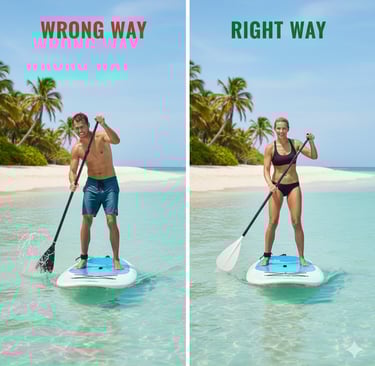
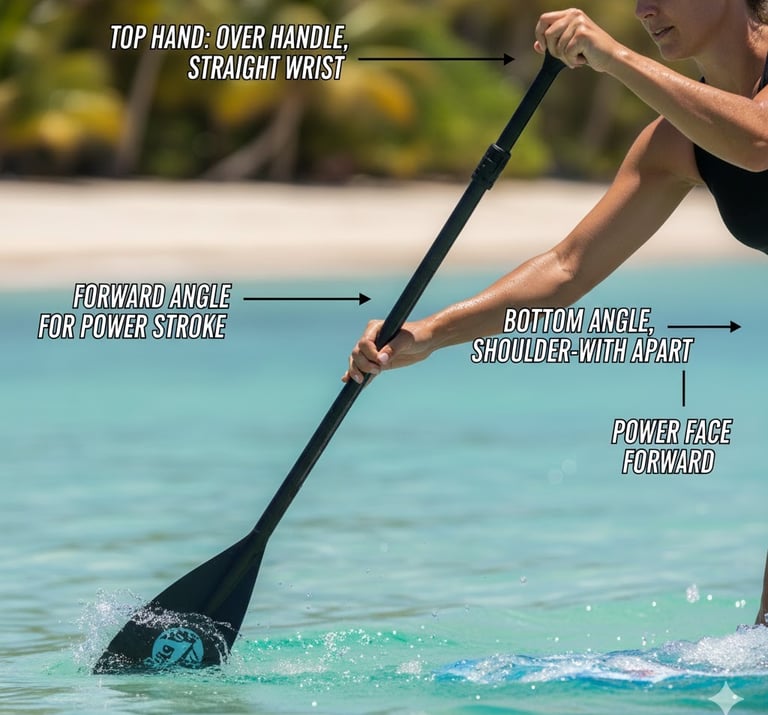
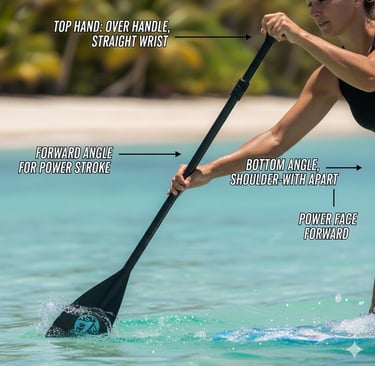
The Fix: Think of your arms as a connection point rather than the engine. Engage your core muscles (abs, obliques, and lower back) to rotate your torso with each stroke. Your top arm should remain relatively straight, acting as a lever, while your bottom arm pulls the paddle through the water. The power comes from unwinding your torso, not from bending your elbows. This technique will give you more power with less effort and help you paddle longer distances without exhaustion.
3. Holding the Paddle Backwards or at the Wrong Angle
It sounds simple, but paddle orientation trips up countless beginners—and some never realize they've got it wrong.
The Mistake: Holding the paddle with the blade angle facing backward (toward you) significantly reduces efficiency. The blade is designed with a specific angle to scoop water effectively when angled away from you.
The Fix: The blade should angle away from you, with the bend in the shaft leaning forward. An easy way to remember: the paddle's logo or any text should be readable when the blade is in the water. Also, make sure your hands are positioned correctly—your top hand should be on the T-grip at the top of the paddle, while your bottom hand should be about shoulder-width down the shaft. Switch your hand positions when you switch sides to maintain proper form.
4. Taking Short, Choppy Strokes
New paddlers often make quick, shallow strokes close to the board, thinking more strokes equal more speed. In reality, this technique is inefficient and exhausting.
The Mistake: Short strokes near the board create minimal forward momentum and cause the board to zigzag rather than track straight. You end up working harder for less distance covered.
The Fix: Reach forward with your paddle and insert the blade fully into the water near the nose of the board. Pull the paddle back in a smooth, controlled motion alongside the rail, ending your stroke at about hip level. The key is to keep the paddle vertical and close to the rail throughout the stroke. A good rule of thumb: longer, more deliberate strokes are far more effective than rapid, short ones. Quality over quantity wins every time.
5. Not Adjusting for Wind and Current Conditions
Even on seemingly calm days, wind and current can significantly impact your paddleboarding experience. Failing to account for these conditions is a mistake that can turn a pleasant outing into an exhausting struggle.
The Mistake: Paddling directly into strong wind or current on your way out means you'll be fighting twice as hard on your return when you're already tired. Many paddlers also don't realize that even light winds can push them farther from shore than intended.
The Fix: Before you head out, check the weather forecast and observe the water conditions. A smart strategy is to paddle into the wind or current first, while you're fresh and have the most energy. This way, you'll have an easier return trip. Always be aware of your surroundings and how far you've drifted. If you're new to an area, start with short trips close to shore until you understand the local conditions. Wearing a leash is also crucial—if you fall off in windy or current-heavy conditions, you don't want your board drifting away faster than you can swim.
Final Thoughts
Paddleboarding is a forgiving sport that welcomes people of all ages and fitness levels, but like any activity, proper technique makes all the difference. By avoiding these five common mistakes, you'll not only improve your paddling efficiency but also prevent unnecessary strain and fatigue.
Remember, every expert paddler was once a beginner. Take time to focus on your form, stay patient with yourself, and most importantly—enjoy the journey. The more you practice with intention, the more natural these techniques will become, and the more you'll love being out on the water.
Now grab your board, hit the water, and paddle with confidence!

It's possible I could earn a commission from the affiliate links on this website. Thank you!
It's possible I could earn a commission from the affiliate links on this website. Thank you!